

Symptoms That Require Professional Attention
If your property exhibits any of the following issues, immediate intervention halts wood rot and prevents structural decking failure:
Where Clearwater Roofs Leak First: Flashing, Vent Boots, Valleys and Skylights
In Clearwater's coastal subtropical climate, roofs endure more than 52 inches of concentrated annual precipitation alongside unrelenting ultraviolet exposure. When a ceiling reveals a brown water stain or an active drip, the problem rarely originates in the center of an undamaged field shingle. Instead, water exploits transitional intersections and penetrations where dissimilar building materials meet.
Plumbing vent pipe boots represent the single most common failure point on Pinellas County roofs built or reroofed between 2005 and 2018. The rubber collar (neoprene boot) that seals around plumbing exhaust pipes degrades under intense Florida heat within 7 to 10 years, cracking and turning brittle long before the surrounding 30-year architectural shingles reach the end of their lifespan. Once the collar fractures, rainwater channels directly down the outside of the PVC pipe into your ceiling cavity.
Step flashing and counterflashing along exterior stucco walls, chimneys, and dormers create another chronic leak hazard. In many Clearwater ranch and mid-century homes, older metal flashing was installed without modern kick-out diverters. Wind-driven rain running down exterior vertical walls misses the gutter and funnels behind the wall cladding, saturating both the roof deck and the interior wall framing.
Finding the Source: Attic Check, Moisture Readings and Controlled Water Testing
Water follows the path of least resistance across gravity-defying paths. A roof leak can enter the deck sheathing at a ridge vent or valley high on the roof slope, travel down the top edge of a sloping wooden rafter for fifteen feet, encounter a ceiling electrical box or drywall seam, and finally drip into a master bedroom. Cutting open the drywall directly below the drip without tracing the rafter run guarantees you will fix the wrong problem.
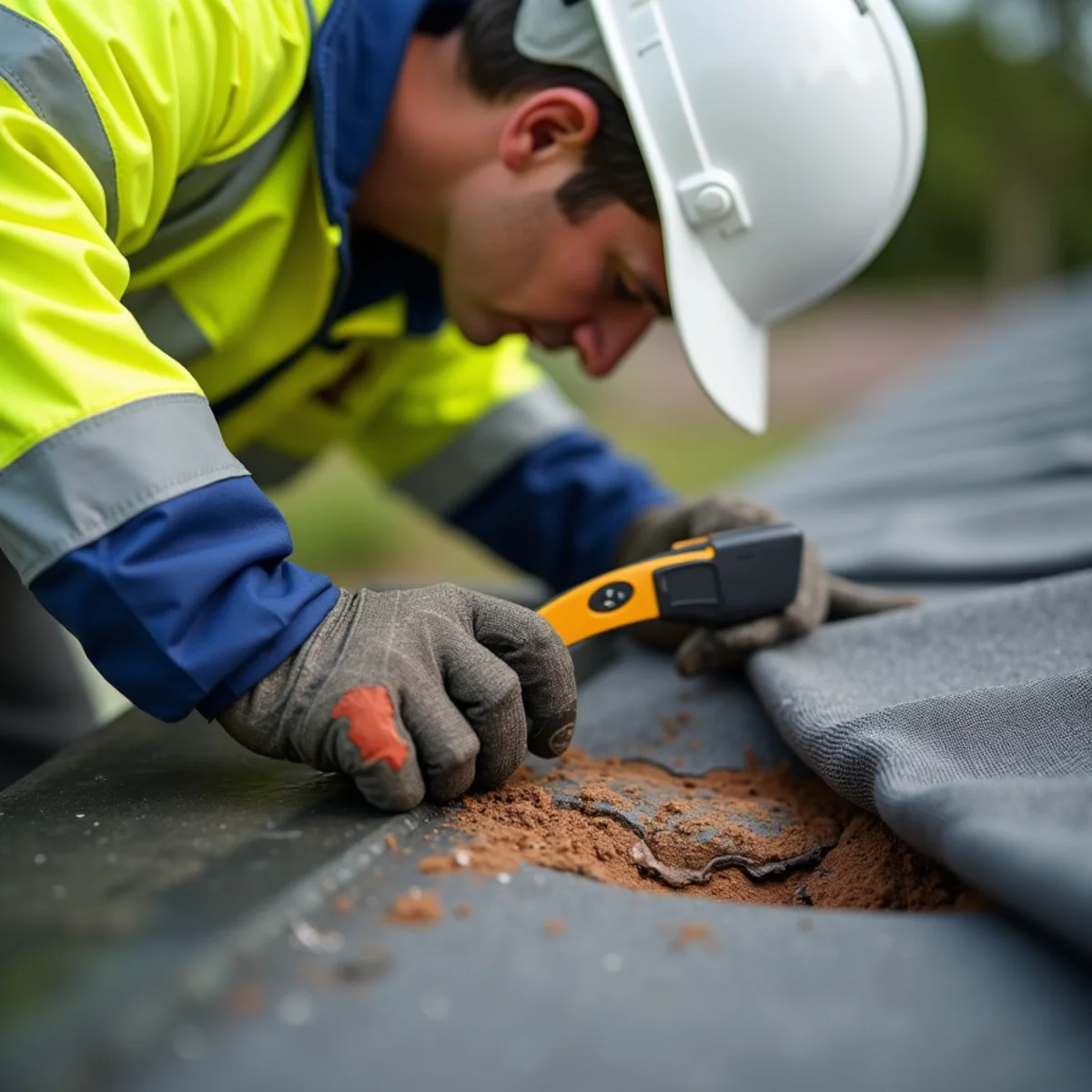
Our diagnostic approach begins inside the attic whenever access is safe and practical. Technicians utilize high-intensity lighting and non-destructive digital moisture meters to map damp pathways across roof trusses, underlayment seams, and insulation batts. We look for rusted nail shanks, black fungal stains on plywood decking, and telltale water tracks along roof penetrations.
When leaks only present during specific conditions—such as sideways wind-driven coastal squalls—we execute systematic, controlled water testing. Starting at the lowest downslope penetration and working progressively upward, we isolate individual roof components until moisture sensor readings pinpoint the precise ingress coordinate.
Need Urgent Roof Leak Repair in Clearwater?
Call (773) 207-0769 for immediate routing to our nearest Pinellas County crew. Written estimates upfront.

Shingle Roof Leak Repairs: Lifted Tabs, Nail Pops, and Cracked Pipe Boots
Asphalt shingle repairs must be executed with surgical precision to avoid tearing brittle surrounding tabs. On homes with roofs ten years or older, shingles become stiff and lose granule adhesion when disturbed in extreme heat. We use flat pry bars to release the factory sealant strips gently, expose the rusted fasteners responsible for nail pops, and replace compromised fasteners with heavy-gauge hot-dipped galvanized or ring-shank roofing nails driven into sound wood.
Where pipe boots have failed, we do not simply slather caulk or roofing mastic over the cracked rubber collar—a temporary band-aid that bakes and peels within months. Instead, we remove the surrounding shingles, lift the damaged boot, install an all-metal flashing base or a commercial-grade silicone collar rated for 25+ years of direct Florida UV exposure, flash it under the upper shingle courses, and seal the perimeter with high-performance polyurethane roofing sealant.
Leaks That Only Show in Wind-Driven Rain: The Gulf Coast Reality
Clearwater homeowners frequently experience a frustrating puzzle: a roof that stays completely dry during a calm four-hour soaking rain suddenly streams water during a 20-minute thunderstorm blowing off Clearwater Harbor or the Gulf of Mexico. This happens because high winds generate substantial pressure differentials between the windward roof slope and the interior of the home.
Wind-driven rain acts horizontally, driving water up beneath the laps of unsealed shingles and forcing moisture backward through ridge vents, gooseneck exhaust vents, and off-ridge louver vents. If the secondary water resistance (underlayment) has dried out, pulled away around nail heads, or was never sealed with peel-and-stick membrane, this pressurized water bypasses the shingles entirely.
Repairing wind-driven rain leaks requires evaluating the mechanical attachment of shingles along eaves and rakes, verifying that wind-resistant starter shingles were properly cemented, and upgrading static vents to Florida Building Code High-Velocity Hurricane Zone (HVHZ) rated components with internal storm baffles.
What a Leak Repair Visit Looks Like: From Initial Call to Dry Ceiling
When you call (773) 207-0769, our dispatch coordinates a prompt arrival window with a licensed and insured local roofing crew. If rain is actively falling or a severe storm is imminent, the crew first establishes temporary dry-in protection to protect your home's structural framing and furnishings.
Once on-site, the technician inspects both the exterior roof plane and the interior attic space, takes high-resolution digital photographs of all compromised components, and explains the root cause in plain English. You receive a clear, written scope of repair with upfront pricing before any permanent physical work begins.
Following your approval, repairs are conducted using code-approved materials. All debris, rusted nails, and old shingles are captured with magnetic sweepers and removed from your property. You receive post-repair documentation including close-up photos of the completed work for your personal maintenance records and insurance file.
Our Inspection-to-Completion Process
Thermal & Attic Water Tracing
Water rarely drips straight down. We inspect the attic rafters, roof decking, and insulation to locate the true point of water penetration on the exterior deck.
Exterior Penetration & Flashing Inspection
We examine vulnerable flashings around plumbing vents, chimney joints, skylights, and sidewalls where coastal wind-driven rain penetrates.
Deck & Underlayment Repair
Damaged shingles and rotted decking are removed. We apply self-adhering polymer-modified bitumen underlayment directly to the clean wood deck.
Matching Installation & Seal Verification
High-grade replacement shingles or tiles are installed to match existing profiles, mechanically fastened with ring-shank nails and elastomeric sealant.
What Affects the Cost of Roof Leak Repair in Clearwater?
Rather than providing arbitrary over-the-phone estimates, our contractors evaluate the exact mechanical conditions of your roof plane to provide an accurate, written scope:
- Location and complexity of the leak: simple pipe boot replacements require far less labor than re-flashing a multi-story stucco sidewall.
- Condition of the underlying wooden deck: if trapped water caused wood rot, decking sheathing must be cut back to the nearest rafters and replaced.
- Roof slope and architectural height: steep pitches (7:12 and above) or multi-tier roofs require safety rigging and specialized access equipment.
- Roofing material type: standard 3-tab and dimensional asphalt shingles differ in labor and part sourcing compared to fragile barrel tiles or flat membranes.
Why Pinellas Homeowners Choose Rising Roofers for Roof Leak Repair
Roofing in coastal Florida demands strict technical adherence to building codes and manufacturer specifications. We ensure your home is protected by proven professionals:
Every contractor is vetted for active Florida DBPR licensure, commercial general liability, and mandatory workers’ compensation.
Live emergency intake answers at (773) 207-0769 around the clock. No overseas answering services or unanswered voicemails.
Detailed line-item scopes itemizing labor, materials, permits, and disposal. You approve the exact cost before work begins.
All repairs and installations meet High-Velocity Hurricane Zone (HVHZ) engineering and Florida Building Code wind uplift standards.
Roof Leak Repair — Common Questions
Expert answers regarding Florida building code compliance, timing, and warranties.
For urgent calls involving active ceiling leaks or storm intrusion in Clearwater and surrounding Pinellas County communities, our team coordinates emergency response 24 hours a day, 7 days a week. Dispatch times typically range between 60 and 90 minutes depending on local weather and road conditions.
Have More Questions About Roof Leak Repair?
Our local team is on call 24 hours a day at (773) 207-0769 to discuss your Clearwater roof.
Local Pinellas County Communities We Serve
In addition to Clearwater, our certified roofing crews dispatch across the 30-minute north Pinellas corridor: